
The clocks have gone back here in the UK and it's now properly dark by what seems by mid-morning. The change of the time and seasons makes for a period of sprinting at the evitable Christmas period and being ready for another full year plan. But thanks to our fabulous Lizzie we’ve already got our Christmas party booked, much to celebrate and look forward to.
Last month we promised to get into the data engines, and in particular their quality and recall, so here it is. This is an incredibly important set of platform functionality, Furze builds insights from the worlds messy public data. As such when its messy we’ve got be transparent about what is good and what is lest trustworthy. Something that many other well known platforms do not offer.
It's also been Phil's first full month on the team (and Mika's, who has been quietly building economic models whilst the rest of us debate about verbs) and between us we've pushed out 248 production releases in the last 30 days, up from 64 the month before. Nobody has slept much, but the product has come on leaps and bounds!
Furze Verified: confidence you can trust
Back in July I said the world's data is a mess, and I'm afraid it hasn't tidied itself up since. Most market data you'll come across is a confident guess. A database tells you Company A supplies Company B and that's that. How does it know? When did it last look? Is it still true? You'll rarely get an answer to any of those, and if you're building an investment case on top of it, you probably should.
Which is why this month every statement Furze makes to a user became a graded claim.
That an organisation is who we say it is. That it belongs in a market. That it supplies, owns, regulates or competes with someone. That it sells a particular product. Each one now carries a grade on the Admiralty scale (source reliability A to F, information credibility 1 to 6, borrowed from the intelligence world where they've been arguing about this for a lot longer than we have), the evidence behind it, and one plain-English band that users actually see: Furze Verified or Unverified.
The bit we're most pleased with is that the grade moves. Evidence can expire, a cheaper re-check can renew it, a person can overrule the machine, and the whole lot gets re-graded every day.
There are 24,284 graded claims in the platform this week and each one gets more trustworthy the longer it stays with us, because we keep going back to look. That's the opposite of most databases, where a fact is at its freshest the day it's typed in and quietly goes off from then on.
So every market page, organisation page and network graph now opens on the verified view, with a single control to widen it out. You choose how much doubt you're comfortable with, and you can see exactly what we've checked and what we haven't. We think that's what honest data looks like, and it's the base everything else this year gets built on.
Finding more, high quality relationships to build systems of connectivity
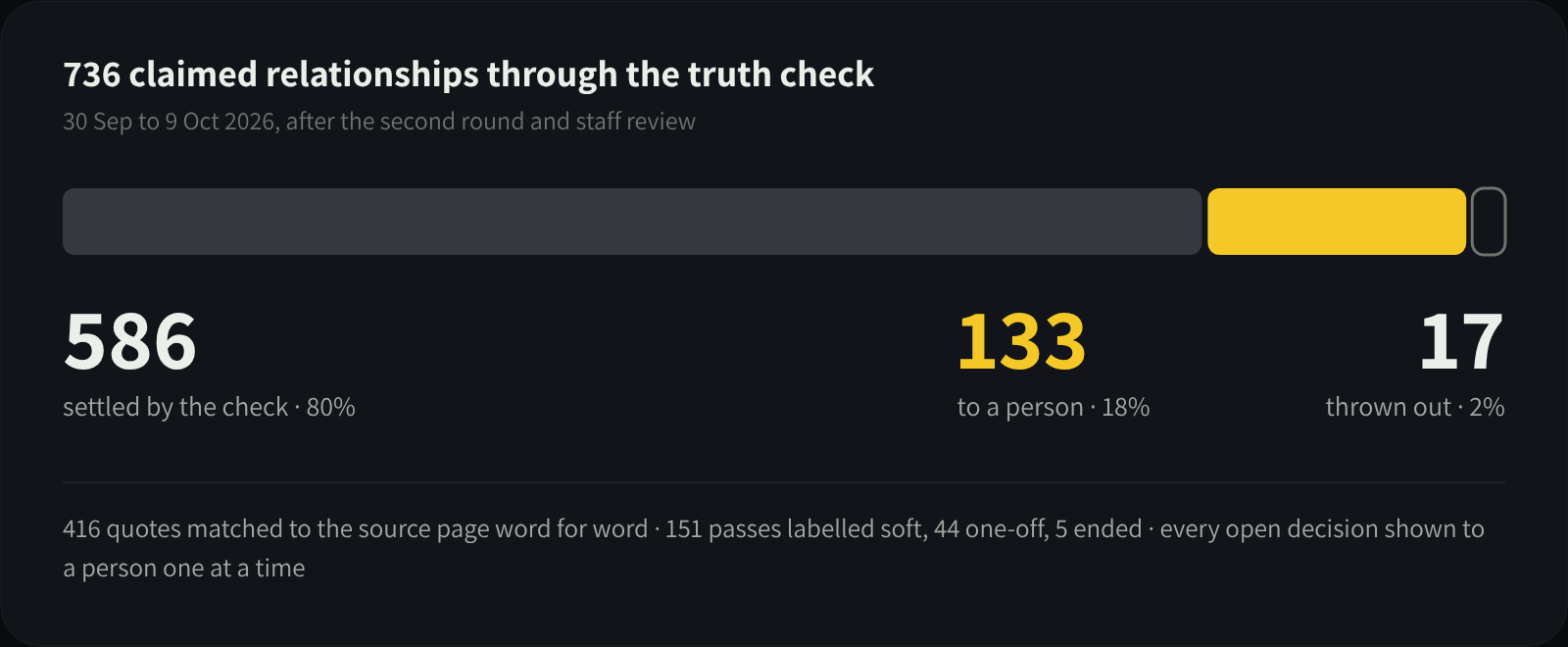
The relationship pipeline has been rebuilt around a check that does what any good analyst would do: go and read the source. For each claimed relationship a truth check researches it on the web, brings back a quote, and we then confirm that quote against the page ourselves.
In the first three weeks of running it for real, 736 claimed relationships went through. The check settled 80% of them on its own, threw 2% out, and sent 18% to Firehills to review.
That 18% is the whole point. Those are the relationships the model isn't sure about, which (no surprise) are exactly the ones our clients would want a human to look at. So the run page now shows each open decision one at a time, with the evidence next to it, and nothing publishes until someone has made the call. Automation for the volume, people for the small but unclear details. That's the balance we've learnt works.
And we’ve got an even stronger pipeline in the works where we connect up Furze to sources of data which provide a stronger and more trustworthy set of relationships.
Products and services: what you sell is who you are
Industry codes tell you what an organisation was registered as. Its products and services tell you what it actually does.
The gap between those two things is where most of the interesting strategy hides, and it's a gap we've wanted to get into for a while.
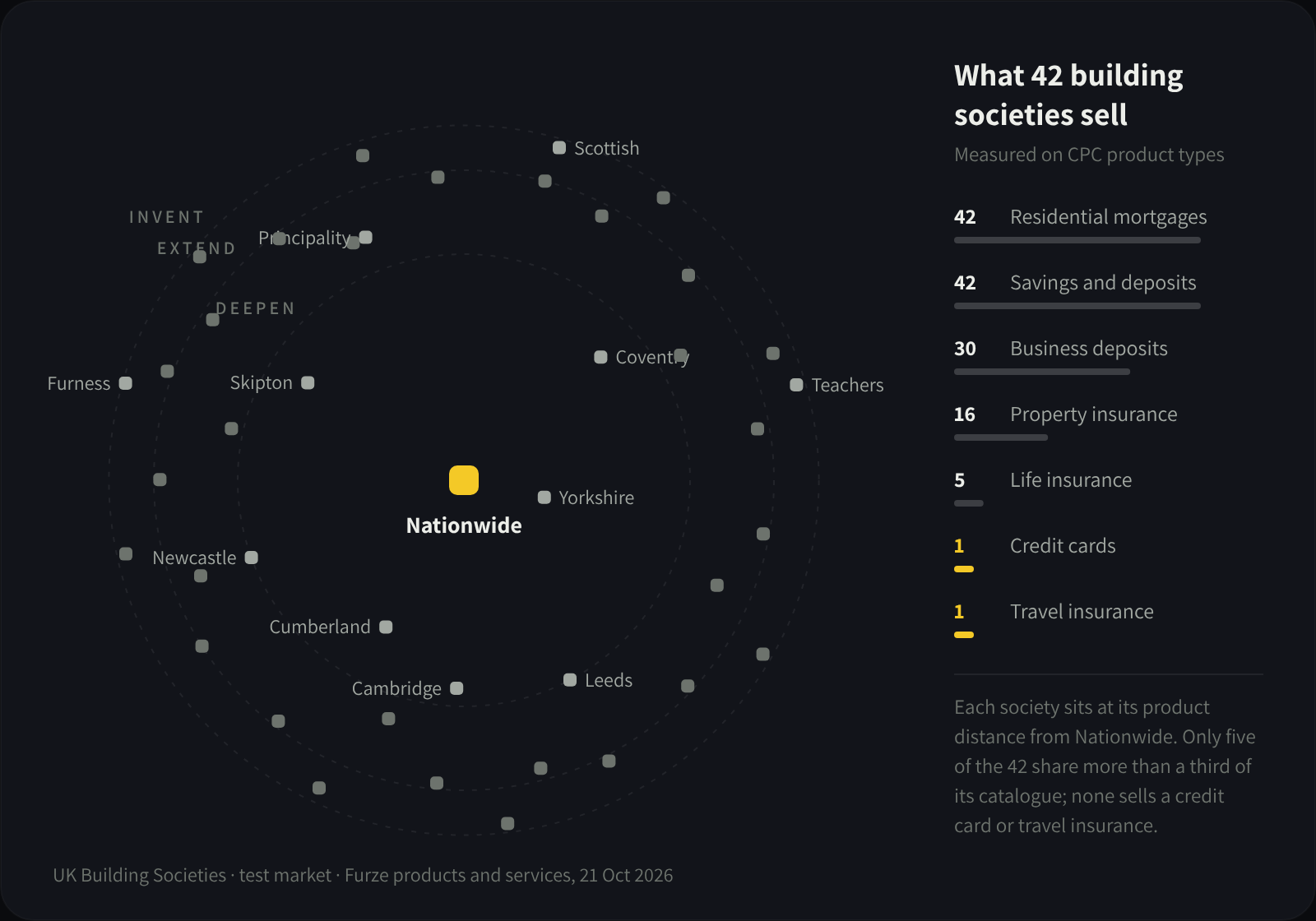
Furze now gathers an organisation's products and services from its own website, grounds each one in the page it came from, and classifies it against the UN's Central Product Classification so that two companies describing the same thing in different words land in the same category.
Do that across a whole market and the market page can start answering questions a list never could.
Who sells something nobody else in this market sells?
Who's launching new innovation to market rather than re-describing old ones?
Which two competitors are, underneath the branding, selling the same catalogue?
That last question is where this is heading.
We have already released our Value Assessment and Growth Scenarios as part of previous update.
We working next to build in relatedness and distance. Namely, how far does an organisation's catalogue sit from its neighbours', its customers' and the market next door?
A Deepen option is a short hop. An Extend option is a longer one. An Invent option is a leap, and we'll be able to say how long each leap is, with the evidence, rather than drawing an arrow on a slide and hoping for the best.
This at its heart is really starting to make complexity actionable. This is our mission and commitment as a team at Firehills.
The same measure turns the growth claims in an investment memorandum into something you can test: if a target says it's moving into an adjacent market, we can show you how adjacent it really is.
And we’re not just saying it, we’re going to prove it. Through Furze we are going to pick some large markets and companies and look at the related pattern data to showcase where could the likes of Unilever, British Airways and other large firms go next.
What’s next?
We’ve got a stacked plan of deliverables through to January next year, including revised public web content, improving all our data pipelines into new revisions and our first work on our brand new systems role framework.
Our call to action for all readers is the same as ever. If you've got a market you’d like to understand, map and create a dataset for a given need then feel free to get in touch at rob@firehills.io.
Till next month.
Rob
