
Furze Product Update: June 26
Today is Tuesday 23rd of June, just at the start of a heatwave in the UK which has been having a profound effect on productivity at Firehills. We’ve been discussing how to keep cool, including solar powered fan hats and converting wheelie bins into plunge pools. We always said that having fun was a key part of working together and jokes help you keep your mind off all the ice lollies in the freezer.
But none the less there is much to share about the direction of Furze.
We promised in May as per the MVP release to share more about the capability of Furze, diving into different parts of the product and sharing what we have built.
This update will be largely focused on our approach to understanding organisational capability, driven by the classic framework known as Business Model Canvas. Although its got a Firehills twist.
Background
Back in 2024 we started exploring how well AI could understand the concepts of Business Model Canvas (BMC), does it easily understand clear definitions of what it is and then how can in consume data about an organisation to produce the assets behind it? One example is, can it identify Value Propositions? Can it describe them well and can it relate back to the sources to ground them in truth?
We must have tested close to about 30+ different organisations and overtime we worked out what the recipe is for doing this consistently well and most importantly in a way which shows the interlocking value of an organisations business model. BMC doesn’t show disparate pieces of a business model, it should show how the whole canvas is connected and how this drive organisational and customer value.
But the answer was a clear yes, it can do this and it can do it very well.
What we have built?
As of today we have got a validated approach to BMC, whereby we can produce a business model for any organisation.
AI generates the entire canvas in just 10 minutes, this exercise some years ago used to take weeks of time with lots of time with executives, business unit leaders, lots of whiteboards/flipcharts and then time to create the clear output. A huge amount of time to get to a very concise output. These times are now a thing of the past.
Furze has been developed from the start to achieve a good outcome from just public data alone. But it can also use private data as well, if a new strategy has been established and organisations want to see how this would affect their business model then this can be achieved.
Summaries and High Fidelity
When we started with Furze delivering BMC we ensured that we got all the content we could ever need. Long form content, with all the detail to tell the story of that business model. Long form content has its place and is valuable for getting under the skin of a business. But this level of detail is chewy and we always knew we needed a better on platform way to walk through BMC. As part of our MVP release we have created two new views:
Orbit: See across the entire canvas in summary form
Flow: Where you drop into a value proposition to understand how its really works and how capability create customer value
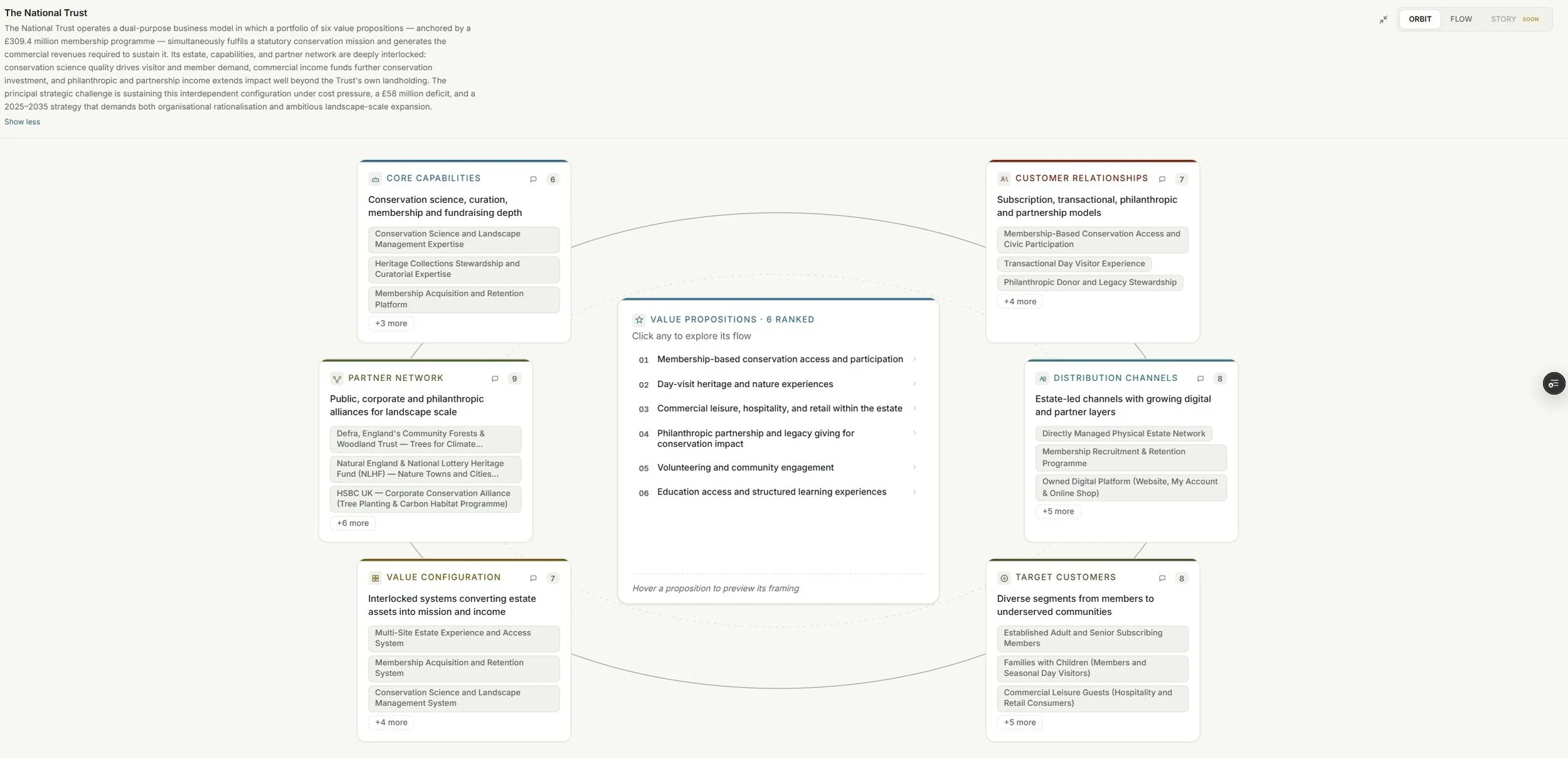
Example of BMC Orbit View for The National Trust, covering their entire business model.
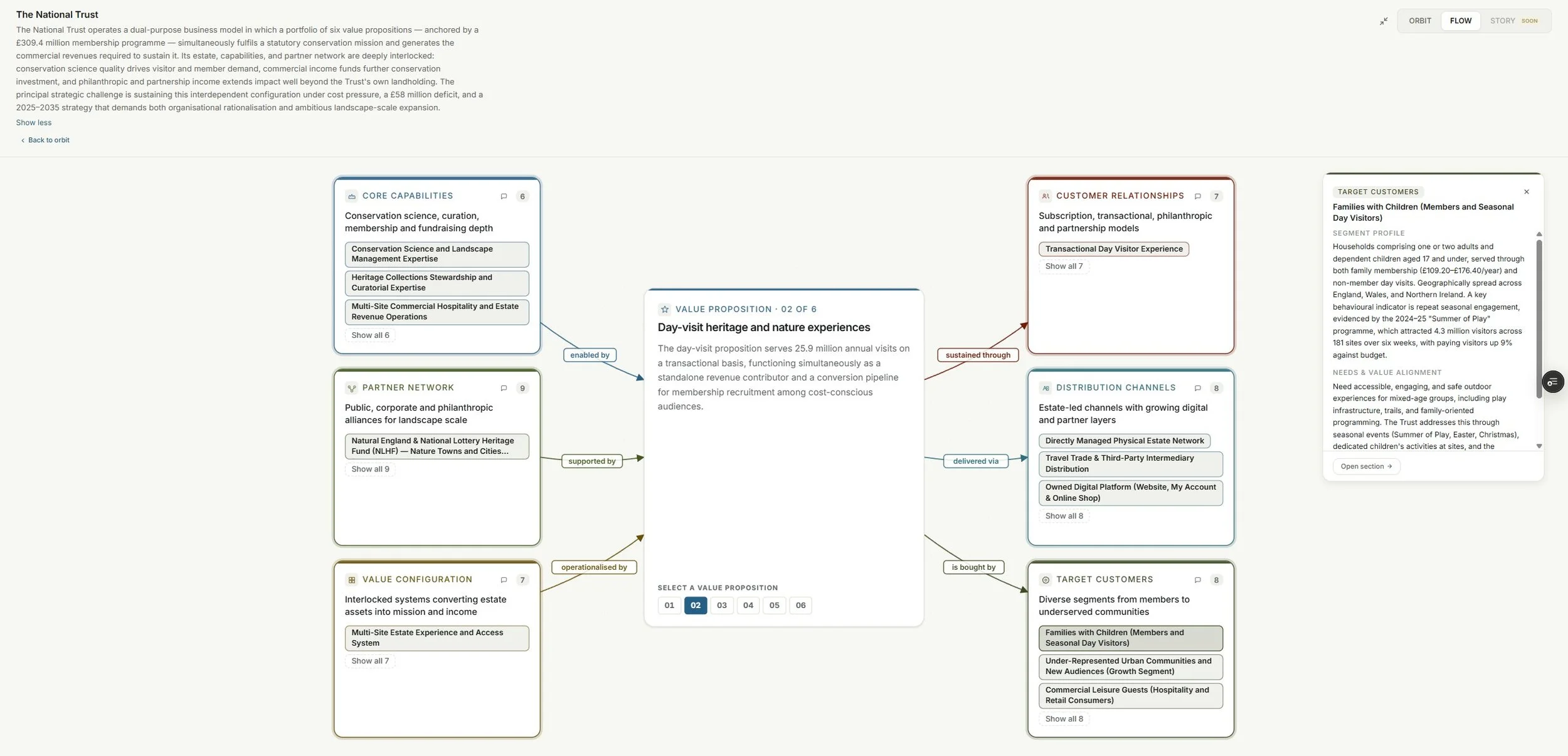
Example of BMC Flow view for The National Trust, focusing on their Day Visitor value proposition
Who is this for?
We’ve built this for a number of different use cases, they are:
For teams that work on investment opportunities (buying/selling an asset), in private equity and also in M&A deal broking. Being able to review the value of an asset and how a business model works and quickly is key. Deal teams have to handle and review many different opportunities every month. Furze and BMC cuts this time down and provided high qualatitive value to the investment thesis
Corporate strategy in organisations often are tasked with reviewing different growth options (or creating them) but often can’t see the capabilities which exist in an organisation to deliver it. Because organisations become siloed, hard to communicate across them to realise its potential. BMC can reveal this, either through single or a book of BMCs for different business units.
Did you know Furze can see into the future?
Forgive the clickbait style heading, but entertain this thought.
In a recent project with a public sector client we used Furze to discover their current business setup, although not a business in a traditional sense they still operate like one. With capabilities being what they can do and their customers being society and the public.
But what we wanted to do was ask Furze to reflect on its future aspiration to deliver public value over the next 25 years. What would their business model look like then? And to our surprise it actually did a stellar job, not being too far into the unrealistic future but grounded in what their strategy was. We actually produced two canvases, one the current model and one the future model. Which showcases the change and evolution of the organisation. Validated in the room with the client, they could see how their strategy could become a reality.
What’s next?
Next month we will be covering more about how we discover markets and identify organisations in markets. To build growth strategies (the primary goal of Furze) you need to know who is operating and what they do. Furze has two large data pipelines built on AI which create market data at scale which create perspectives on the interactions and system that organisations are within.
Would you like to see your business model canvas?
We are offering a limited number of completely free business model canvas outputs to our network, in return for your feedback. We’d also like to offer some of our time to showcase this to you as well. Get in touch via rob@firehills.io
